
To understand the mechanism(s) of pathogenicity of bacteria and fungi pathogens

Phytopathogens Cause Harmful, Widespread Diseases In A Very Broad Range Of Plant Species Worldwide. Damage To Cultivated Plants Is Often Sufficient To Cause Significant Yield Losses. The Percent Of Worldwide Crop Losses Caused By Plant Pathogens, Insects, Pests, And Weeds Has Been Estimated To 42%, Accounting For 500 Billion Worth Of Damage. Out Of This Global, Losses Caused By Pathogen Alone Are Estimated To Be 14.1% Of Potential Crop Production. Now The Control Of Any Fungal And Bacterial Pathogen Must Need To First Understand The Pathogenesis Mechanism. It Does Not Only Give Information About How The Fungal And Bacterial Pathogen Infects Host Plants But Also Provides Valuable New Strategies To Prevent Its Growth And Development. Phytopathogen Attacks On Target Cells And Produced The Extracellular Enzyme (CWDE) Is One Of The Virulence Factors In Bacterial And Fungal Infection. CWDE Functions To Break Down The Components Of Host Cell Walls And May Play A Crucial Role In Virulence And Bacterial Nutrition. The Secretion Of Extracellular Enzymes, Such As Pectin Esterases, Polygalacturonases, Xylanases, Pectate Lyases, And Cellulases, Is An Essential Process For Colonization And Pathogenicity. Bacteria Also Secrete The Small Molecules As Virulence Factors, Such As Toxins, Plant Hormones, Protein, And Exopolysaccharides (EPS) To Promote Disease. During Infection, Pathogens Can Elevate The Host’s Normal Auxin Level Either By Synthesizing Auxin Themselves Or By Providing An Effector To Enhance Plant-induced Auxin Synthesis. Using Diverse Mechanisms Of Action, Including Mimicking Plant Hormones, Forming Pores In Plant Membranes, Or Inhibiting Host Metabolic Enzymes, These Toxins Can Cause Necrotic Or Chlorotic Symptoms On Affected Plants. Plant Hormones Play Decisive Roles In Growth And Development Of Plants And Are Equally Important In The Interaction Of Plant With Microorganisms During Pathogenesis Or Symbiosis.
Objective of work

To Isolate The Bacteria And Fungi From The Different Infected Plant Materials. To Study The Mechanism Of Infection By Investigating Various Cell Wall Degrading Enzymes And Hormones Production By Bacteria And Fungi. Auxin Production Was Determined From The Different Bacteria And Fungi. Further, It Was Confirmed By HPLC Analysis.
Major finding results:

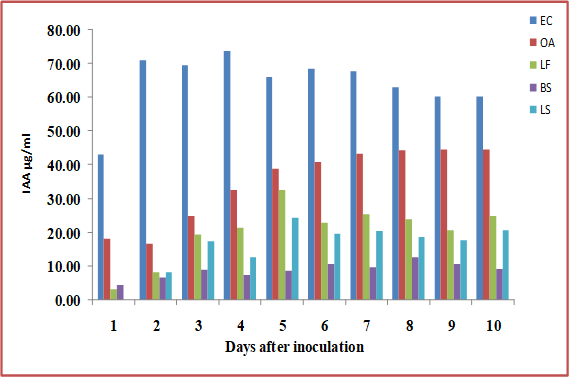
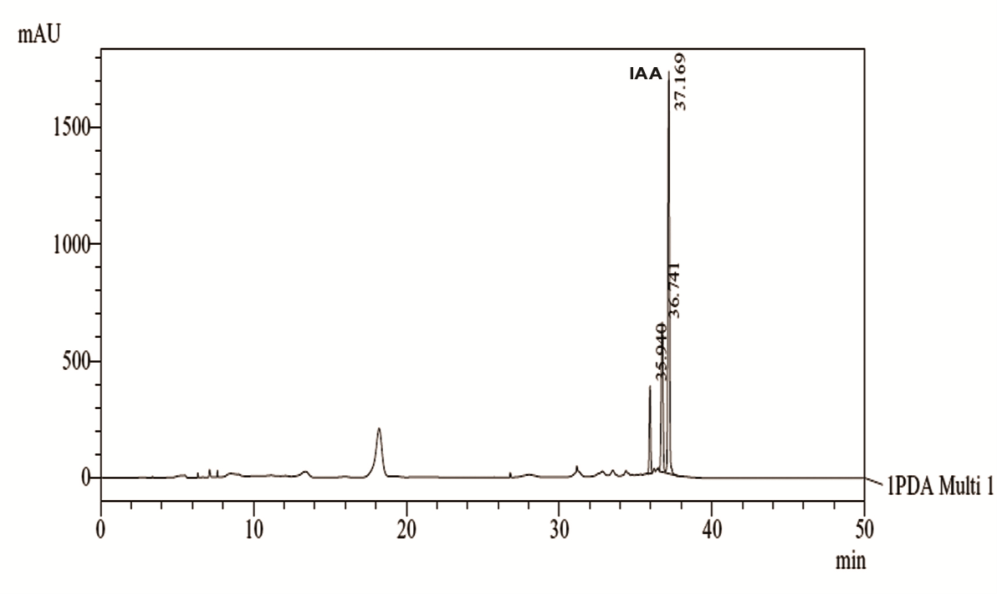
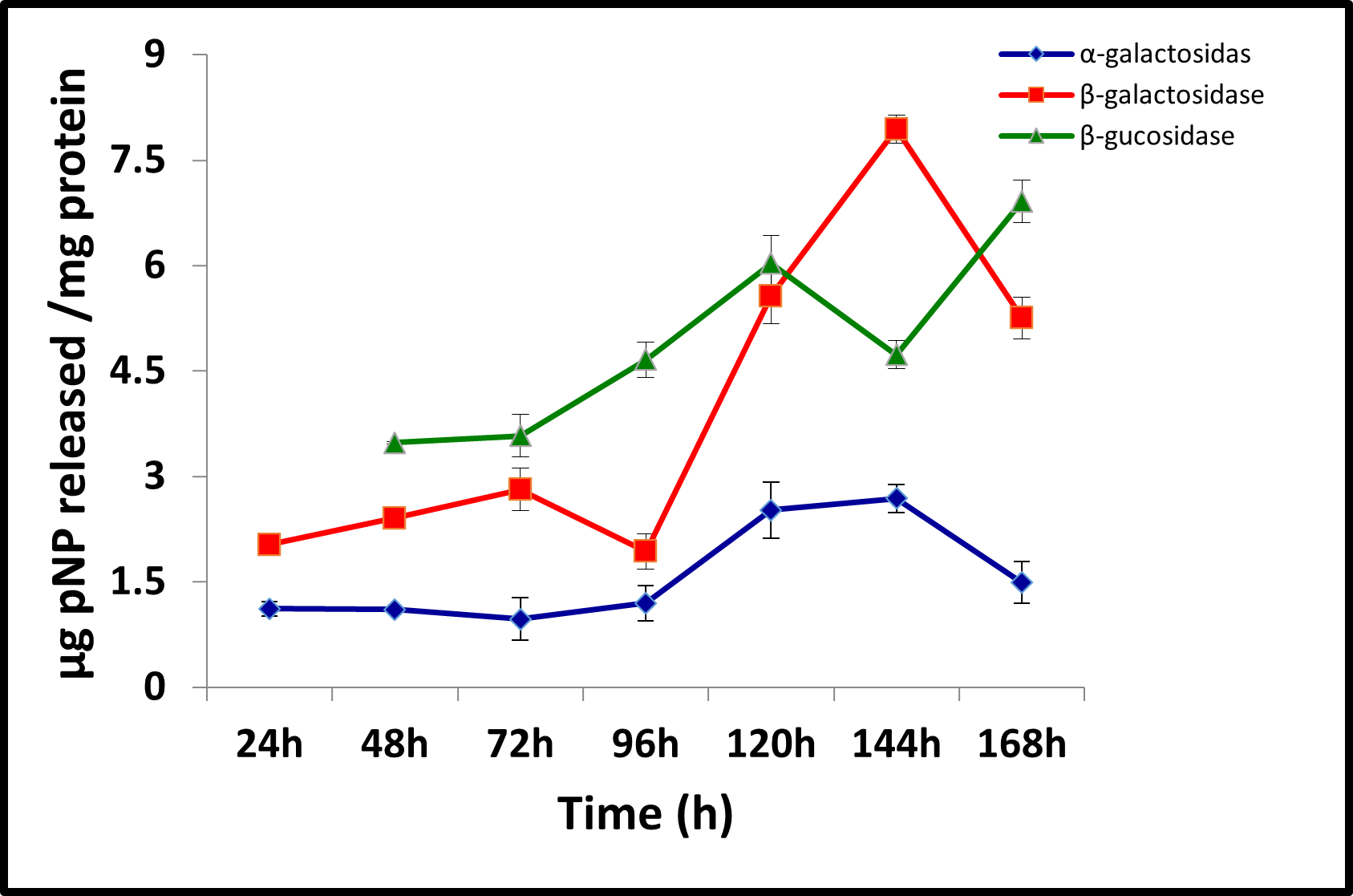
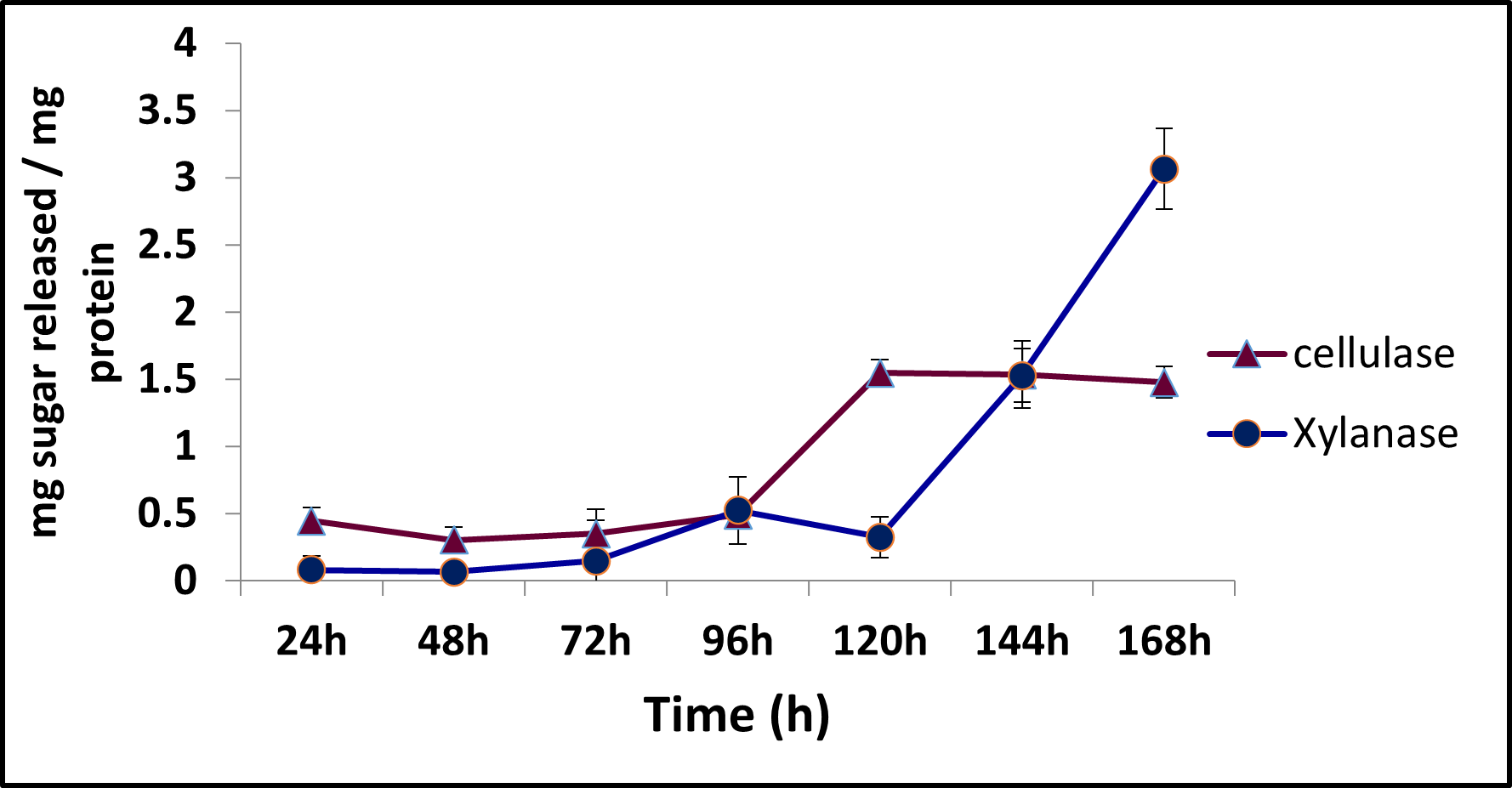
All The Isolated Bacteria And Fungi Produced More Or Less Amount Of Cellulase, Polygalacturonase, Xylanase And Invertase, α-D-galactosidase, β-D- Galactosidase, And β-D- Glucosidase In All The Tested Media. The Highest Level Of IAA Production Was Recorded In Bacterial Culture During The Early And Late Growth Phase Of Bacteria. Maximum IAA Was Produced By Erwinia Chrysanthemi Compared To All Others Tested Bacteria In Tryptophan Containing Medium. The Results Of HPLC Analysis Showed Similarity Of Bacterial Extracted IAA With Standard IAA.
IAA production with time changes by different bacteria
Chromatogram for production of IAA from Erwinia chrysanthemi
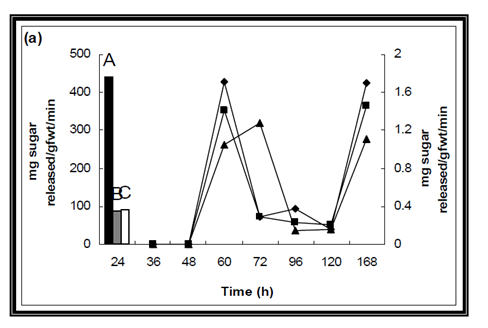
Glucosidase and galactosidase enzyme activity in X.campestirs against time
Cellulase and xylanase activity in X.campestirs against time
Secretion of Polygacturonase by Aspergillus niger
Outputs of work:
Amongst The Various Enzymes Degrading Plant Cell Wall, Cellulase, Xylanase Was Produced Maximum Compared To All The Enzymes Tested; Implying That It Might Be The Most Useful Enzyme In Initial Penetration Activities. The Finding Of Cell Wall Degrading Enzymes During Initial To Later Phase Of Tested Bacterial Pathogens Suggests One Of The Most Significant Tool Utilized By Them During Pathogenicity. All Auxin Producing Bacteria Might Have The Gene For IAA Synthesis Which Would Express During Pathogenicity. It May Be Possible That At The Initial Stage Of Infection, Pathogens Generate IAA, Hydrolyze Plant Cell Wall Polysaccharides And The Cell Wall Saccharides That Are Released Can Serve As An Ideal Nutrition Supply To Pathogens For Survival And Later Proliferation. The Mechanism Of Pathogenesis And Identification Of Bacteria And Fungi Can Be Useful For Control Of Disease.
Publications
V.C. Pawar And V.S. Thaker (2009) Acid Phosphatase And Invertase Activities Of Aspergillus Niger. Mycoscience 50(5):323-330 K.S. Chudasama And V. S. Thaker (2012) Secretion Of Type II Extracellular Cell Wall Degrading Enzymes From Pantoea Agglomerans Phytopathogen. In Asian Journal Of Plant Science Research. 2 (5):559-565. ISSN-2249-7412 K. S. Chudasama, R. S. Chudasama And V. S. Thaker (2014) Understanding The Effect Of Seed Pathogenic Bacteria In Release Of Conjugated Forms Of Endogenous Hormones From The Seed Of Cajanus Cajan By Indirect ELISA. Science Research Reporter, 4(1): 113-118. K. S. Chudasama And V. S. Thaker (2015) Auxin Production From Phytopathogenic Organisms. Plant Cell Biotechnology And Molecular Biology. 16(3&4):130-136